Which Supreme Court Case Established the Power of Judicial Review
| Marbury v. Madison | |
|---|---|
 Supreme Court of the U.s. | |
| Argued Feb 11, 1803 Decided Feb 24, 1803 | |
| Full case name | William Marbury v. James Madison, Secretary of State of the United states of america |
| Citations | 5 U.S. 137 (more) 1 Cranch 137; ii 50. Ed. 60; 1803 U.S. LEXIS 352 |
| Decision | Opinion |
| Example history | |
| Prior | Original activeness filed in U.S. Supreme Court; order to show cause why writ of mandamus should not issue, December 1801 |
| Holding | |
| Section 13 of the Judiciary Act of 1789 is unconstitutional to the extent it purports to enlarge the original jurisdiction of the Supreme Courtroom beyond that permitted past the Constitution. Congress cannot pass laws that are contrary to the Constitution, and information technology is the office of the judiciary to interpret what the Constitution permits. | |
| Court membership | |
| |
| Case opinion | |
| Majority | Marshall, joined past Paterson, Chase, Washington |
| Cushing and Moore took no part in the consideration or determination of the example. | |
| Laws practical | |
| U.Southward. Const. arts. I, Three; Judiciary Act of 1789 § 13 | |
Marbury v. Madison , v U.S. (1 Cranch) 137 (1803), was a landmark U.S. Supreme Courtroom case that established the principle of judicial review in the The states, meaning that American courts have the power to strike down laws and statutes that they find to violate the Constitution of the U.s.. Decided in 1803, Marbury is regarded as the single nigh important decision in American constitutional police force.[1] The Court'south landmark decision established that the U.South. Constitution is actual police force, non simply a statement of political principles and ethics, and helped define the purlieus betwixt the constitutionally separate executive and judicial branches of the federal regime.
The case originated in early 1801 as function of the political and ideological rivalry between approachable President John Adams and incoming President Thomas Jefferson.[2] Adams had lost the U.S. presidential ballot of 1800 to Jefferson, and in March 1801, just ii days before his term as president ended, Adams appointed several dozen Federalist Political party supporters to new circuit approximate and justice of the peace positions in an try to frustrate Jefferson and his supporters in the Democratic-Republican Party.[3] The U.S. Senate apace confirmed Adams's appointments, but upon Adams' difference and Jefferson's inauguration a few of the new judges' commissions still had not been delivered.[3] Jefferson believed the undelivered commissions were void and instructed his Secretary of State, James Madison, not to deliver them.[4] One of the undelivered commissions belonged to William Marbury, a Maryland businessman who had been a strong supporter of Adams and the Federalists. In tardily 1801, after Madison had repeatedly refused to deliver his commission, Marbury filed a lawsuit in the Supreme Court asking the Courtroom to issue a writ of mandamus forcing Madison to deliver his committee.[v]
In an opinion written past Chief Justice John Marshall, the Courtroom held firstly that Madison's refusal to deliver Marbury's commission was illegal, and secondly that it was unremarkably proper for a courtroom in such situations to order the authorities official in question to deliver the commission.[6] Only in Marbury'south example, the Court did not club Madison to comply. Examining the department of the police Congress had passed that gave the Supreme Court jurisdiction over types of cases similar Marbury'due south, the Court plant that it had expanded the definition of its jurisdiction beyond what was originally prepare along in the U.Southward. Constitution.[7] The Courtroom so struck down that department of the law, announcing that American courts have the ability to invalidate laws that they find to violate the Constitution.[8] Because this meant the Court had no jurisdiction over the case, it could non effect the writ that Marbury had requested.
Background

President John Adams, who appointed Marbury just before his presidential term ended.

Thomas Jefferson, who succeeded Adams and believed Marbury'southward undelivered commission was void.
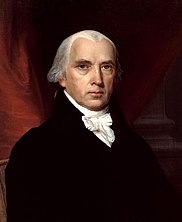
James Madison, Jefferson's Secretary of State, who withheld Marbury'south committee.
In the fiercely contested U.S. presidential election of 1800, the three primary candidates were Thomas Jefferson, Aaron Burr, and the incumbent President John Adams.[1] Adams espoused the pro-business concern and pro-national-government politics of the Federalist Political party and its leader Alexander Hamilton, while Jefferson and Burr were office of the opposing Autonomous-Republican Party, which favored agriculture and decentralization. American public opinion had gradually turned against the Federalists in the months leading up to the election, mainly due to their use of the controversial Alien and Sedition Acts, as well as growing tensions with Slap-up United kingdom, with whom the Federalists favored close ties.[nine] Jefferson easily won the popular vote but only narrowly defeated Adams in the Electoral College.
Equally the results of the election became clear, Adams and the Federalists became determined to exercise their remaining influence before Jefferson took office and did everything they could to fill federal offices with "anti-Jeffersonians" who were loyal to the Federalists.[two] [10] On March 2, 1801, just two days before his presidential term concluded,[note 1] Adams nominated nearly lx Federalist supporters to new circuit judge and justice of the peace positions the Federalist-controlled Congress had recently created. These final-minute nominees—whom Jefferson'due south supporters derisively called the "Midnight Judges"—included William Marbury, a prosperous businessman from Maryland.[11] An agog Federalist, Marbury was active in Maryland politics and had been a vigorous supporter of the Adams presidency.[12]
The following day, March iii, the Senate canonical Adams's nominations en masse. The appointees' commissions were immediately written out, then signed past Adams and sealed past Secretary of Land John Marshall, who had been named the new Chief Justice of the Supreme Court in Jan only continued also serving as secretary of state for the residuum of Adams' term.[10] [13] Marshall then dispatched his younger blood brother James Markham Marshall to deliver the commissions to the appointees.[5] With simply one day left before Jefferson's inauguration, James Marshall was able to evangelize virtually of the commissions, but a few—including Marbury'southward—were non delivered.[10]
The 24-hour interval after, March 4, 1801, Jefferson was sworn in and became the 3rd President of the Us. Jefferson instructed his new Secretary of State, James Madison, to withhold the undelivered commissions.[10] In Jefferson's opinion, the commissions were void because they had not been delivered before Adams left office.[4] Without the commissions, the appointees were unable to assume the offices and duties to which they had been appointed.
Over the side by side several months, Madison continually refused to deliver Marbury's commission to him. Finally, in December 1801, Marbury filed a lawsuit against Madison in the U.S. Supreme Court, request the Court to forcefulness Madison to deliver his committee.[10] This lawsuit resulted in the case of Marbury five. Madison.
Decision

On February 24, 1803,[notation 2] the Supreme Courtroom issued a unanimous 4–0 decision[note 3] against Marbury. The Court'southward opinion was written by Chief Justice John Marshall, who structured the Court's stance around a series of three questions information technology answered in plough:
- Get-go, did Marbury have a right to his committee?
- Second, if Marbury had a correct to his commission, was at that place a legal remedy for him to obtain it?
- Third, if there was such a remedy, could the Supreme Court legally issue it?[fourteen]
Marbury's correct to his committee
The Court began by determining that Marbury had a legal right to his committee. Marshall reasoned that all advisable procedures were followed: the committee had been properly signed and sealed.[xv] Madison had argued that the commissions were void if not delivered, simply the Court disagreed, saying that the commitment of the committee was merely a custom, not an essential element of the commission itself.[6]
The [President'southward] signature is a warrant for affixing the keen seal to the commission, and the great seal is only to be affixed to an instrument which is consummate. ... The manual of the commission is a practise directed by convenience, but non by police force. It cannot therefore be necessary to establish the appointment, which must precede it and which is the mere act of the President.
— Marbury v. Madison, 5 U.S. at 158, 160.
The Court said that because Marbury'southward commission was valid, Madison's withholding it was "violative of a vested legal correct" on Marbury'due south part.[sixteen]
Marbury's legal remedy
Turning to the second question, the Court said that the police force provided Marbury a remedy for Madison's unlawful withholding of his commission from him. Marshall wrote that "information technology is a general and indisputable rule, that where there is a legal right, there is also a legal remedy by suit or action at law, whenever that right is invaded." This dominion derives from the ancient Roman legal maxim ubi jus, ibi remedium ("where in that location is a legal right, there is a legal remedy"), which was well established in the early on Anglo-American common law.[17] [18] In what the American legal scholar Akhil Amar called "i of the nigh important and inspiring passages" of the opinion,[xix] Marshall wrote:
The very essence of ceremonious liberty certainly consists in the correct of every individual to claim the protection of the laws whenever he receives an injury.
— Marbury, 5 U.S. at 163.
The Court then confirmed that a writ of mandamus—a blazon of courtroom society that commands a government official to perform an act their official duties legally require them to perform—was the proper remedy for Marbury'south state of affairs.[20] But this raised the issue of whether the Court, which was part of the judicial branch of the government, had the power to control Madison, who as secretary of country was part of the executive branch of the government.[14] The Courtroom held that then long as the remedy involved a mandatory duty to a specific person, and not a political matter left to discretion, the courts could provide the legal remedy.[21] Borrowing a phrase John Adams had drafted in 1779 for the Massachusetts State Constitution, Marshall wrote: "The authorities of the United states of america has been emphatically termed a regime of laws, and not of men."[22]
The Supreme Court's jurisdiction

This brought Marshall to the third question: did the Supreme Court take proper jurisdiction over the example that would let it to issue the writ of mandamus?[24] The answer depended entirely on how the Court interpreted the text of the Judiciary Act of 1789. Congress had passed the Judiciary Human action to establish the American federal court system, since the U.S. Constitution merely mandates a Supreme Court and leaves the rest of the U.Southward. federal judicial power to reside in "such inferior Courts every bit the Congress may from time to time ordain and establish."[25] Section xiii of the Judiciary Act sets out the Supreme Courtroom's original and appellate jurisdictions.
And be information technology further enacted, That the Supreme Court shall accept exclusive [original] jurisdiction over all cases of a civil nature where a country is a political party ... And shall have exclusively all such jurisdiction of suits or proceedings against ambassadors, or other public ministers ... The Supreme Court shall also have appellate jurisdiction from the circuit courts and courts of the several states, in the cases herein after specially provided for; and shall have power to issue ... writs of mandamus, in cases warranted past the principles and usages of law, to any courts appointed, or persons holding office, under the authority of the United States.
—Judiciary Act of 1789, Section 13 (accent added)
Marbury had argued that the language of Section xiii of the Judiciary Act gave the Supreme Court the authority to consequence writs of mandamus when hearing cases nether original jurisdiction, not just appellate jurisdiction.[24] As Marshall explains in the opinion, original jurisdiction gives a courtroom the ability to exist the first to hear and decide a case; appellate jurisdiction gives a courtroom the power to hear an appeal from a lower court's decision and to "revise and correct" the previous decision.[8] Although the language on the power to consequence writs of mandamus appears after Section 13's sentence on appellate jurisdiction, rather than with the earlier sentences on original jurisdiction, a semicolon separates it from the clause on appellate jurisdiction. The department does not make articulate whether the mandamus clause was intended to exist read as part of the appellate clause or on its own—in the opinion, Marshall quoted merely the end of the section[26]—and the law's diction tin plausibly be read either fashion.[27] In the end, the Courtroom agreed with Marbury and interpreted section 13 of the Judiciary Act to have authorized the Court to practise original jurisdiction over cases involving disputes over writs of mandamus.[28] [29]
But as Marshall pointed out, this meant that the Judiciary Act contradicted Article Three of the U.S. Constitution, which establishes the judicial branch of the U.Due south. government. Commodity III defines the Supreme Court'due south jurisdiction equally follows:
In all Cases affecting Ambassadors, other public Ministers and Consuls, and those in which a Land shall be Party, the supreme Court shall have original Jurisdiction. In all the other Cases before mentioned, the supreme Courtroom shall have appellate Jurisdiction, both as to Police and Fact, with such Exceptions, and under such Regulations as the Congress shall make.
—U.S. Constitution, Article 3, Section 2 (emphasis added).
Article Iii says that the Supreme Court merely has original jurisdiction over cases where a U.S. country is a party to a lawsuit or where a lawsuit involves strange dignitaries. Neither of these categories covered Marbury'due south lawsuit, which was a dispute over a writ of mandamus for his justice of the peace commission. So, according to the Constitution, the Courtroom did not have original jurisdiction over a case similar Marbury'south.[8] [28]
But the Court had interpreted the Judiciary Act to accept given it original jurisdiction over lawsuits for writs of mandamus. This meant that the Judiciary Deed had taken the Constitution'due south initial scope for the Supreme Court's original jurisdiction, which did not embrace cases involving writs of mandamus, and expanded information technology to include them. The Court ruled that Congress cannot increase the Supreme Court'southward original jurisdiction equally information technology was set down in the Constitution, and information technology therefore held that the relevant portion of Section 13 of the Judiciary Act violated Article Iii of the Constitution.[28]
Judicial review and striking downward the law
After ruling that it conflicted with the Constitution, the Court struck downward Department xiii of the Judiciary Act in the U.S. Supreme Court's first ever annunciation of the power of judicial review.[8] [xxx] The Court ruled that American federal courts accept the ability to refuse to give any effect to congressional legislation that is inconsistent with their interpretation of the Constitution—a move known as "hitting down" laws.[31]
The U.S. Constitution does not explicitly give the American judiciary the power of judicial review.[32] Nevertheless, Marshall'south opinion gives a number of reasons in support of the judiciary's possession of the power. Start, the Courtroom reasoned that the written nature of the Constitution inherently established judicial review.[33] [34] Borrowing from Alexander Hamilton's essay Federalist No. 78, Marshall wrote:
The powers of the legislature are defined and limited; and that those limits may not be mistaken or forgotten, the constitution is written. ... Certainly all those who have framed written constitutions contemplate them every bit forming the fundamental and paramount police force of the nation, and consequently the theory of every such regime must exist, that an act of the legislature, repugnant to the constitution, is void.
— Marbury, 5 U.S. at 176–77.[35]
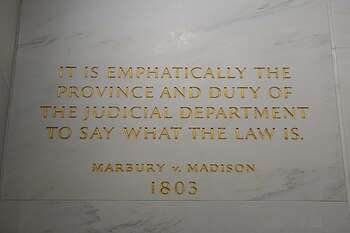
2d, the Court declared that deciding the constitutionality of the laws information technology applies is an inherent part of the American judiciary's role.[36] In what has become the almost famous and oft quoted line of the stance, Marshall wrote:
It is emphatically the province and duty of the Judicial Department to say what the police force is.
— Marbury, 5 U.Due south. at 177.[37]
Marshall reasoned that the Constitution places limits on the American authorities's powers, and that those limits would be meaningless unless they were subject to judicial review and enforcement.[34] [36] He reasoned that the Constitution's provisions limiting Congress'southward power—such as the export taxation clause or the prohibitions on bills of attainder and ex post facto laws—meant that in some cases judges would be forced to choose between enforcing the Constitution or following Congress.[38] Marshall held "virtually as a thing of iron logic" that in the effect of disharmonize betwixt the Constitution and statutory laws passed by Congress, the constitutional law must exist supreme.[8]
Third, the Court said that denying the supremacy of the Constitution over Congress'due south acts would mean that "courts must close their eyes on the constitution, and see merely the law."[39] This, Marshall wrote, would make Congress omnipotent, since none of the laws it passed would ever exist invalid.[34]
This doctrine ... would declare, that if the legislature shall exercise what is expressly forbidden, such human action, notwithstanding the express prohibition, is in reality effectual. Information technology would be giving to the legislature a applied and real omnipotence, with the same breath which professes to restrict their powers inside narrow limits.
— Marbury, 5 U.Southward. at 178.[forty]
Marshall and so gave several other reasons in favor of judicial review. He reasoned that the authorization in Commodity III of the Constitution that the Court tin make up one's mind cases arising "nether this Constitution" implied that the Courtroom had the power to strike down laws alien with the Constitution.[36] This, Marshall wrote, meant that the Founders were willing to have the American judiciary use and interpret the Constitution when judging cases. He too said that federal judges' oaths of office—in which they swear to discharge their duties impartially and "agreeably to the Constitution and laws of the The states"—requires them to support the Constitution.[41] Lastly, Marshall reasoned that judicial review is unsaid in the Supremacy Clause of Article VI of the U.Southward. Constitution, since it declares that the supreme law of the U.s.a. is the Constitution and laws made "in Pursuance thereof", rather than the Constitution and all federal laws generally.[42] [41]
Having given his list of reasons, Marshall concluded the Court's opinion by reaffirming the Court's ruling on the invalidity of Department 13 of the Judiciary Act and, therefore, the Court's inability to issue Marbury's writ of mandamus.
Thus, the particular phraseology of the Constitution of the The states confirms and strengthens the principle, supposed to be essential to all written Constitutions, that a law repugnant to the Constitution is void, and that courts, every bit well as other departments, are spring by that instrument. The rule must be discharged.
— Marbury, five U.S. at 180.
Analysis
Political dilemma

Principal justice John Marshall, equally painted by Henry Inman in 1832, after having presided over the American federal judiciary for over 30 years
Besides its legal issues, the instance of Marbury v. Madison likewise created a difficult political dilemma for John Marshall and the Supreme Court.[43] If the Court had ruled in Marbury'south favor and issued a writ of mandamus ordering Madison to evangelize Marbury's commission, Jefferson and Madison would probably have simply ignored it, which would have fabricated the Courtroom look impotent and emphasized the "shakiness" of the judiciary.[43] On the other hand, a unproblematic ruling against Marbury would take given Jefferson and the Democratic-Republicans a clear political victory over the Federalists.[43] Marshall solved both problems. First, he had the Court rule that Madison'southward withholding of Marbury's commission was illegal, which pleased the Federalists. Only the stance he wrote also held that the Courtroom could not grant Marbury his requested writ of mandamus, which gave Jefferson and the Autonomous-Republicans the consequence they desired.
Simply in what the American legal scholar Laurence Tribe calls "an oft-told tale ... [that] remains awe-inspiring", Marshall had the Courtroom rule against Marbury in a way that maneuvered Marbury's uncomplicated petition for a writ of mandamus into a example that presented a question that went to the middle of American constitutional law itself.[44] The American political historian Robert G. McCloskey describes:
[Marbury v. Madison] is a masterwork of indirection, a brilliant example of Marshall's chapters to sidestep danger while seeming to court information technology. ... The danger of a caput-on clash with the Jeffersonians was averted past the denial of jurisdiction: but, at the same time, the declaration that the commission was illegally withheld scotched any impression that the Court condoned the administration's behavior. These negative maneuvers were artful achievements in their own right. Only the impact of genius is evident when Marshall, non content with having rescued a bad situation, seizes the occasion to set along the doctrine of judicial review. Information technology is easy for us to see in hindsight that the occasion was golden, ... simply only a estimate of Marshall's discernment could accept recognized it.[45]
Marshall had been looking for a example suitable for introducing judicial review and was eager to use the situation in Marbury to establish his claim.[46] He introduced judicial review—a move Jefferson decried—merely used it to strike downward a provision of a law that he read to have expanded the Supreme Court'southward powers, and thereby produced Jefferson's hoped-for result of Marbury losing his example.[47] Marshall "seized the occasion to uphold the institution of judicial review, but he did so in the course of reaching a judgment that his political opponents could neither defy nor protest."[48] Though Jefferson criticized the Court'southward decision, he accustomed it, and Marshall's opinion in Marbury "clear[d] a role for the federal courts that survives to this day."[49] The American legal scholar Erwin Chemerinsky concludes: "The brilliance of Marshall'due south opinion cannot be overstated."[47]
Legal criticism
Marshall'south historic opinion in Marbury v. Madison continues to exist the subject of critical analysis and enquiry.[50] In a 1955 Harvard Police Review article, U.S. Supreme Court Justice Felix Frankfurter emphasized that one tin criticize Marshall's opinion in Marbury without demeaning it: "The courage of Marbury v. Madison is not minimized by suggesting that its reasoning is not impeccable and its conclusion, however wise, not inevitable."[51]
Criticisms of Marshall's opinion in Marbury usually fall into two general categories.[l] First, some criticize the mode Marshall "strove" to reach the decision that the U.South. Supreme Court has ramble authority over the other branches of the U.S. government. Today, American courts generally follow the principle of "constitutional avoidance": if a certain interpretation of a law raises constitutional problems, they prefer to use alternative interpretations that avert these problems, and so long every bit the culling interpretations are even so plausible.[52] In Marbury, Marshall could have avoided the constitutional questions through different legal rulings: for example, if he had ruled that Marbury did non accept a right to his commission until it was delivered, or if he had ruled that refusals to honor political appointments could only exist remedied through the political process and not the judicial process, information technology would accept ended the case immediately and the Court would not take reached the case'south constitutional problems.[53] Marshall did not practise and then, and many legal scholars have criticized him for it.[52] Some scholars have responded that the "constitutional avoidance" principle did not exist in 1803, and in any case is "only a general guide for Courtroom action", not an "ironclad rule".[54] Alternatively, it has also been argued that the claim that Marshall "strove" to create a controversy largely vanishes when the example is viewed from the legal perspective of the late 18th century, when American colonies' and states' supreme courts were largely modeled on England's Court of Rex's Demote, which inherently possessed mandamus powers.[55]
Second, Marshall's arguments for the Court'due south authority are sometimes said to be mere "serial of assertions", rather than substantive reasons logically laid out to support his position.[56] Scholars generally agree that Marshall'south series of assertions regarding the U.South. Constitution and the actions of the other branches of government do not "inexorably pb to the conclusion that Marshall draws from them."[56] Marshall's exclamation of the American judiciary's authority to review executive branch actions was the nearly controversial issue when Marbury was first decided, and several subsequent U.Southward. presidents have tried to dispute information technology, to varying degrees.[56]
Additionally, information technology is questionable whether Marshall should have participated in the Marbury instance because of his participating part in the dispute.[xiv] Marshall was even so the acting secretarial assistant of state when the nominations were made, and he had signed Marbury and the other men's commissions and had been responsible for their delivery.[fourteen] This potential conflict of interest raises strong grounds for Marshall to have recused himself from the case.[14] In retrospect, the fact that Marshall did not recuse himself from Marbury is likely indicative of his eagerness to hear the case and employ it to establish judicial review.[53]
Legacy
Marbury five. Madison is regarded as the single most important decision in American ramble law.[i] It established U.S. federal judges' authority to review the constitutionality of Congress's legislative acts,[one] and to this twenty-four hours the Supreme Court's power to review the constitutionality of American laws at both the federal and state level "is generally rested upon the epic conclusion of Marbury v. Madison."[57]
Although the Court's opinion in Marbury established judicial review in American federal police, it did non invent or create it. Some 18th-century British jurists had argued that English courts had the power to circumscribe Parliament.[58] The thought became widely accustomed in Colonial America—peculiarly in Marshall's native Virginia—under the rationale that in America simply the people were sovereign, rather than the government, so the courts should only implement legitimate laws.[58] [59] By the time of the Constitutional Convention in 1787, American courts' "contained ability and duty to interpret the law" was well established,[60] and Hamilton had dedicated the concept in Federalist No. 78. Nevertheless, Marshall'due south stance in Marbury was the ability's beginning announcement and exercise by the Supreme Court. It made the practice more routine, rather than exceptional, and prepared the way for the Courtroom'southward opinion in the 1819 case McCulloch v. Maryland, in which Marshall implied that the Supreme Courtroom was the supreme interpreter of the U.Southward. Constitution.[61]
Although it is a potent cheque on the other branches of the U.Due south. government, federal courts rarely exercised the power of judicial review in early American history. After deciding Marbury in 1803, the Supreme Court did non strike down another federal police force until 1857, when the Court struck downwardly the Missouri Compromise in its now-infamous decision Dred Scott v. Sandford, a ruling that contributed to the outbreak of the American Ceremonious State of war.[62]
Encounter also
- Australian Communist Party five Commonwealth
- Calder five. Balderdash
- Hylton v. U.s.
- Martin v. Hunter'southward Lessee
References
Notes
- ^ The U.Due south. Constitution originally had new presidents take office in early March, which left a 4-month gap between elections the previous Nov and presidential inaugurations. This inverse in 1933 with the adoption of the Twentieth Subpoena to the U.S. Constitution, which moved presidential inaugurations up to January xx and thereby reduced the period between elections and inaugurations to nigh 2-and-a-one-half months.
- ^ In retaliation for Adams's appointment of the "Midnight Judges", Jefferson and the new Autonomous-Republican Congressmen passed a bill that canceled the Supreme Court'due south 1802 term. This prevented all its pending cases, including Marbury five. Madison, from being decided until 1803.
- ^ Due to illnesses, justices William Cushing and Alfred Moore did not sit for oral argument or participate in the Court's decision.
Citations
- ^ a b c d Chemerinsky (2019), § ii.2.one, p. 39.
- ^ a b McCloskey (2010), p. 25.
- ^ a b Chemerinsky (2019), § 2.2.1, pp. 39–forty.
- ^ a b Pohlman (2005), p. 21.
- ^ a b Chemerinsky (2019), § ii.2.i, p. 40.
- ^ a b Chemerinsky (2019), § 2.two.ane, pp. 41–42.
- ^ Chemerinsky (2019), § two.2.1, p. 44.
- ^ a b c d e Epstein (2014), p. 89.
- ^ McCloskey (2010), pp. 23–24.
- ^ a b c d e Chemerinsky (2019), § 2.2.1, p. 40.
- ^ Brest et al. (2018), p. 115.
- ^ Miller (2009), p. 44.
- ^ Paulsen et al. (2013), p. 141.
- ^ a b c d e Chemerinsky (2019), § 2.ii.1, p. 41.
- ^ Chemerinsky (2019), § 2.2.i, p. 41.
- ^ Chemerinsky (2019), § 2.ii.1, p. 42.
- ^ Amar (1989), p. 447.
- ^ Amar (1987), pp. 1485–86.
- ^ Amar (1987), p. 1486.
- ^ Brest et al. (2018), pp. 124–25.
- ^ Chemerinsky (2019), § two.2.1, pp. 42–43.
- ^ Chemerinsky (2019), § ii.two.1, p. 41, quoting Marbury, v U.S. at 163.
- ^ The Former Supreme Court Sleeping room, 1810–1860 (PDF). Role of Senate Curator (Report). U.S. Senate Commission on Art. 2015-06-24 [2014-02-ten]. S. Pub. 113-3.
- ^ a b Chemerinsky (2019), § ii.2.i, p. 43.
- ^ Chemerinsky (2012), pp. 3, 9 (quoting U.S. Constitution, Article III, Section one).
- ^ Van Alstyne (1969), p. fifteen.
- ^ Nowak & Rotunda (2012), § 1.3, p. l.
- ^ a b c Chemerinsky (2019), § 2.2.1, p. 44.
- ^ Fallon et al. (2015), pp. 69–seventy.
- ^ Currie (1997), p. 53.
- ^ Tribe (2000), p. 207.
- ^ Tribe (2000), pp. 207–08.
- ^ Prakash & Yoo (2003), p. 914.
- ^ a b c Tribe (2000), p. 210.
- ^ Quoted in part in Chemerinsky (2019), § 2.2.1, p. 45, and Tribe (2000), p. 210.
- ^ a b c Chemerinsky (2019), § 2.two.one, p. 45.
- ^ Quoted in Chemerinsky (2019), § 2.2.i, p. 45.
- ^ Nowak & Rotunda (2012), § 1.3, pp. 52–53.
- ^ Tribe (2000), p. 210, quoting Marbury, 5 U.S. at 178.
- ^ Quoted in Tribe (2000), p. 210.
- ^ a b Nowak & Rotunda (2012), § 1.3, p. 53.
- ^ Chemerinsky (2019), § 2.2.1, p. 46.
- ^ a b c McCloskey (2010), p. 26.
- ^ Tribe (2000), p. 208, annotation 5.
- ^ McCloskey (2010), pp. 25–27.
- ^ Nowak & Rotunda (2012), § 1.4(a), p. 55.
- ^ a b Chemerinsky (2019), § two.2.1, p. 46.
- ^ Fallon et al. (2015), p. 69.
- ^ Chemerinsky (2019), § 2.2.ane, pp. 46–47.
- ^ a b Nowak & Rotunda (2012), § 1.4(a), p. 54.
- ^ Frankfurter (1955), p. 219
- ^ a b Brest et al. (2018), pp. 133–34.
- ^ a b Nowak & Rotunda (2012), § 1.4(a), p. 55.
- ^ Nowak & Rotunda (2012), §1.4(a), pp. 55–56.
- ^ Pfander (2001), pp. 1518–xix.
- ^ a b c Nowak & Rotunda (2012), § 1.four(a), p. 56.
- ^ Van Alstyne (1969), p. 1.
- ^ a b Cornell & Leonard (2008), p. 540.
- ^ Treanor (2005), p. 556.
- ^ Paulsen (2003), p. 2707.
- ^ Cornell & Leonard (2008), p. 542.
- ^ Chemerinsky (2019), § two.two.i, p. 47.
Works cited
- Amar, Akhil Reed (1987). "Of Sovereignty and Federalism". Yale Law Periodical. 96 (vii): 1425–1520. doi:10.2307/796493. JSTOR 796493.
- Amar, Akhil Reed (1989). "Marbury, Section 13, and the Original Jurisdiction of the Supreme Court". Academy of Chicago Law Review. 56 (2): 443–99. doi:x.2307/1599844. JSTOR 1599844.
- Brest, Paul; Levinson, Sanford; Balkin, Jack Chiliad.; Amar, Akhil Reed; Siegel, Reva B. (2018). Processes of Constitutional Decisionmaking: Cases and Materials (7th ed.). New York: Wolters Kluwer. ISBN978-1-4548-8749-2.
- Chemerinsky, Erwin (2012). Federal Jurisdiction (6th ed.). New York: Wolters Kluwer. ISBN978-1-4548-0402-four.
- Chemerinsky, Erwin (2019). Constitutional Law: Principles and Policies (6th ed.). New York: Wolters Kluwer. ISBN978-1-4548-9574-ix.
- Cornell, Saul; Leonard, Gerald (2008). "The Consolidation of the Early Federal System, 1791–1812". In Grossberg, Michael; Tomlins, Christopher (eds.). The Cambridge History of Law in America, Volume I: Early America (1580–1815). Cambridge: Cambridge University Printing. pp. 518–54. ISBN978-0-521-80305-2.
- Currie, David P. (1997). The Constitution in Congress: The Federalist Period 1789–1801. Chicago: University of Chicago Press. ISBN9780226131146.
- Epstein, Richard A. (2014). The Classical Liberal Constitution: The Uncertain Quest for Limited Government. Cambridge, Massachusetts: Harvard Academy Printing. ISBN978-0-674-72489-ane.
- Fallon, Richard H., Jr.; Manning, John F.; Meltzer, Daniel J.; Shapiro, David 50. (2015). Hart and Wechsler's The Federal Courts and the Federal Arrangement (7th ed.). St. Paul, Minnesota: Foundation Press. ISBN978-1-60930-427-0.
- Frankfurter, Felix (1955). "John Marshall and the Judicial Function". Harvard Law Review. 69 (ii): 217–38. doi:10.2307/1337866. JSTOR 1337866.
- McCloskey, Robert G. (2010). The American Supreme Court. Revised past Sanford Levinson (5th ed.). Chicago: Academy of Chicago Press. ISBN978-0-226-55686-4.
- Miller, Mark Carlton (2009). The View of the Courts from the Hill: Interactions Between Congress and the Federal Judiciary. Charlottesville: University of Virginia Press. ISBN9780813928104.
- Nowak, John E.; Rotunda, Ronald D. (2012). Treatise on Constitutional Law: Substance and Procedure (5th ed.). Eagan, Minnesota: West. OCLC 798148265.
- Paulsen, Michael Stokes (2003). "The Irrepressible Myth of Marbury". Michigan Law Review. 101 (8): 2706–43. doi:x.2307/3595393. JSTOR 3595393.
- Paulsen, Michael Stokes; Calabresi, Steven G.; McConnell, Michael W.; Bray, Samuel (2013). The Constitution of the United States. University Casebook Serial (2nd ed.). St. Paul: Foundation Press. ISBN978-i-60930-271-ix.
- Pfander, James E. (2001). "Marbury, Original Jurisdiction, and the Supreme Court's Supervisory Powers". Columbia Law Review. 101 (7): 1515–1612. doi:x.2307/1123808. JSTOR 1123808.
- Pohlman, H. L. (2005). Constitutional Fence in Activity: Governmental Powers. Lanham: Rowman & Littlefield. ISBN978-0-7425-3593-0.
- Prakash, Saikrishna; Yoo, John (2003). "The Origins of Judicial Review". University of Chicago Police force Review. 70 (three): 887–982. doi:10.2307/1600662. JSTOR 1600662.
- Treanor, William Michael (2005). "Judicial Review Before Marbury". Stanford Law Review. 58 (2): 455–562. JSTOR 40040272.
- Tribe, Laurence H. (2000). American Ramble Law (3rd ed.). New York: Foundation Printing. ISBN978-1-56662-714-6.
- Van Alstyne, William (1969). "A Critical Guide to Marbury 5. Madison". Duke Law Journal. eighteen (1): ane–49.
Further reading
- Nelson, William E. (2000). Marbury v. Madison: The Origins and Legacy of Judicial Review . Academy Printing of Kansas. ISBN978-0-7006-1062-4. (one introduction to the example)
- Clinton, Robert Lowry (1991). Marbury v. Madison and Judicial Review. University Press of Kansas. ISBN978-0-7006-0517-0. (Claims that it is a mistake to read the case as claiming a judicial ability to tell the President or Congress what they tin can or cannot do under the Constitution.)
- Irons, Peter H. (1999). A People'southward History of the Supreme Court. Penguin Books. pp. 104–107. ISBN978-0-14-029201-5.
- Newmyer, R. Kent (2001). John Marshall and the Heroic Age of the Supreme Court. Louisiana State Academy Press. ISBN978-0-8071-3249-4.
- James Yard. O'Fallon, The Case of Benjamin More: A Lost Episode in the Struggle over Repeal of the 1801 Judiciary Act, 11 Police force & Hist. Rev. 43 (1993).
- Tushnet, Marker (2008). I dissent: Great Opposing Opinions in Landmark Supreme Court Cases. Boston: Beacon Press. pp. 1–16. ISBN978-0-8070-0036-6.
- Sloan, Cliff; McKean, David (2009). The Swell Decision: Jefferson, Adams, Marshall and the Battle for the Supreme Court. New York, NY: PublicAffairs. ISBN978-i-58648-426-two.
- Trachtman, Michael Thousand. (2016-09-06). The Supremes' Greatest Hits, 2nd Revised & Updated Edition: The 44 Supreme Court Cases That Well-nigh Directly Affect Your Life (Third, Revised ed.). Sterling. ISBN9781454920779.
External links
- Text of Marbury 5. Madison, 5 U.S. (1 Cranch) 137 (1803) is available from:Cornell Findlaw Justia Library of Congress OpenJurist
- Primary Documents in American History: Marbury v. Madison from the Library of Congress
- "John Marshall, Marbury 5. Madison, and Judicial Review—How the Court Became Supreme" Lesson plan for grades nine–12 from National Endowment for the Humanities
- The 200th Ceremony of Marbury v. Madison: The Reasons We Should All the same Care About the Decision, and The Lingering Questions It Left Behind
- The Institution of Judicial Review
- The 200th Anniversary of Marbury v. Madison: The Supreme Court'due south First Great Case
- Case Brief for Marbury five. Madison at Lawnix.com
- The curt moving picture Marbury v. Madison (1977) is bachelor for costless download at the Internet Archive.
- "Supreme Court Landmark Case Marbury v. Madison" from C-Span's Landmark Cases: Historic Supreme Court Decisions
Source: https://en.wikipedia.org/wiki/Marbury_v._Madison
0 Response to "Which Supreme Court Case Established the Power of Judicial Review"
Post a Comment